
BioViridian’s search is the simplest of the laboratory lookups, and that is also its catch. It does not return a record. It looks for a PDF named after the code you typed and shows it, so a hit says only that the lab’s server holds a certificate under that number. Everything that makes the result meaningful is a comparison you make yourself, between the file it shows and the copy you were given. This guide covers the code, what the search does, the fields worth comparing and the traps. For the laboratory itself, read our BioViridian review.
How to verify
Verification page: bioviridians.com/coa-search.html
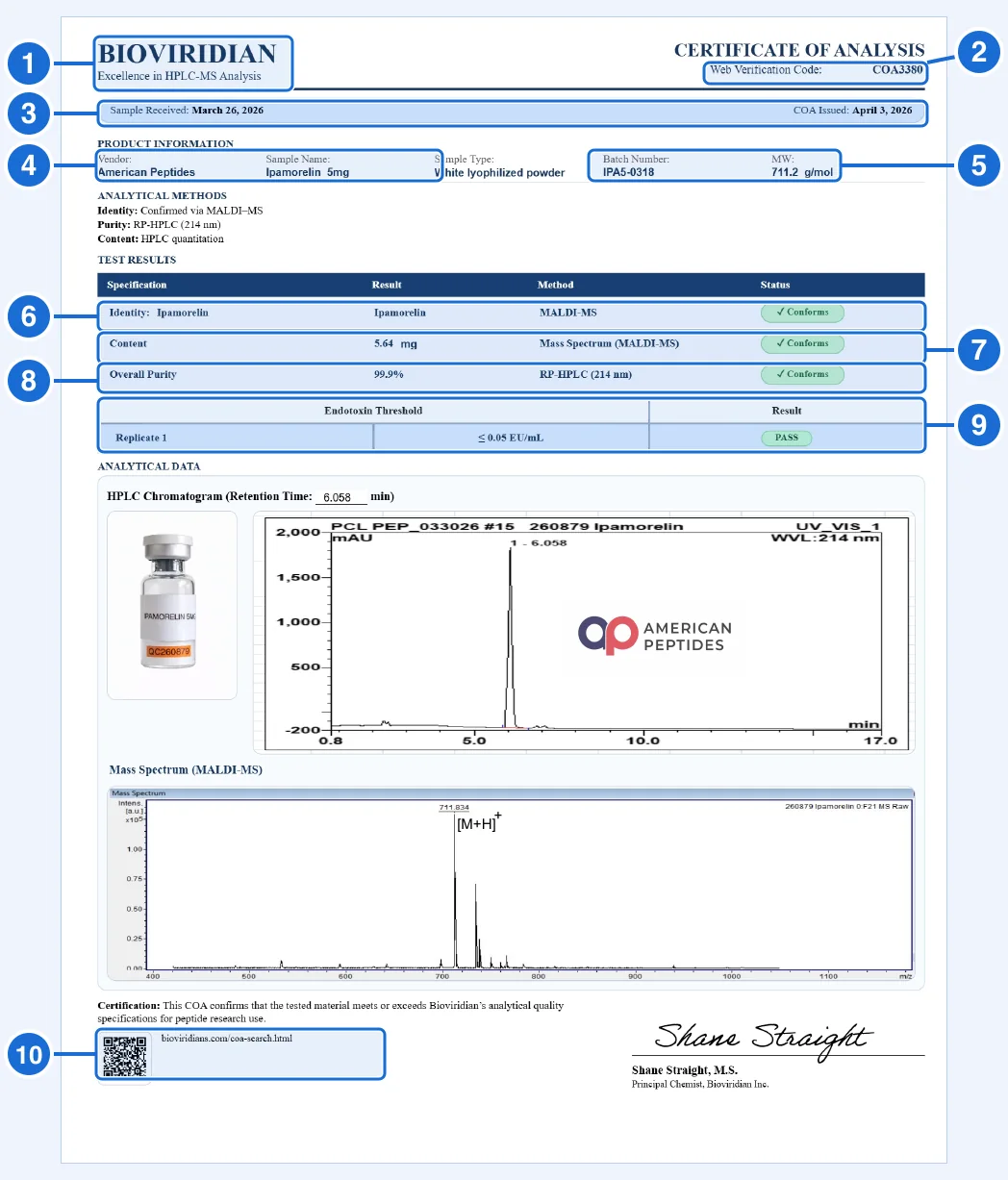
- Lab header. BIOVIRIDIAN and the title. The certificate is signed by Shane Straight, M.S., Principal Chemist, Bioviridian Inc., near the foot.
- Web Verification Code. The lookup input: COA followed by four digits, under CERTIFICATE OF ANALYSIS at the top right. Here COA3380.
- Dates. Sample Received is when the sample reached the lab. COA Issued is the date this certificate was issued.
- Vendor and sample. The vendor on the certificate and the sample name with its labeled strength. The portal shows neither; only the file does.
- Batch number. The lot code to compare with the vial label and the product page. Newer layouts call it Lot Number.
- Identity. The compound and the method that confirmed it.
- Content. The amount in mg that the lab measured, which is a measurement and not a restatement of the label.
- Overall purity. The percentage and the method: RP-HPLC at 214 nm.
- Endotoxin. The threshold and the result. Some layouts add heavy metals and sterility rows; if a seller promises them, they must be on the page.
- QR code and address. On this certificate the QR code opens bioviridians.com/coa-search.html, the search page, not the record. You still type the code.
Type box 2: the Web Verification Code, COA3380. It is the letters COA and four digits, in the header under the title. Box 5 is the batch number, which is not an input. In our library 258 of 261 BioViridian listings print a code in that shape.
What the search actually does
The page has one box, labeled “COA Number:”, with COA3174 and COA3456E as examples. When you click Search it:
- Cleans what you typed. It upper-cases it and removes spaces, so coa 3380 works. The digits alone do not: 7603 finds nothing while COA7603 finds the certificate.
- Looks for a file. It asks the lab’s server whether a PDF named after your code exists, and if not, whether an HTML page does.
- Shows whatever it finds. A hit is headed “Certificate of Analysis – COA3380” with the PDF embedded and two links, Download PDF and Open Full Screen. A miss prints “No COA found for” and the code.
Three things follow. The search proves a file exists, not whose it is. Anyone can open any code, so a seller could print a real code on an edited copy. And the file on the server can change, so the version you see today is the reference. The next sections are how you handle each.
Look one up
- Copy the code from the certificate header.Include the letters COA. If your copy is cropped and the header is missing, ask for the full page: some layouts also print the code faintly across the background.
- Open the search page.bioviridians.com/coa-search.html is headed “COA Search” and says to enter your COA number to access your Certificate of Analysis.
- Type or paste it and click Search.The certificate appears below the box in a viewer. Use Open Full Screen to read it properly.
- Read the file as the reference.Compare it with your copy, field by field, using the next section.
A worked example: Ipamorelin 5mg from American Peptides
American Peptides publishes this certificate for its Ipamorelin 5mg. Searching COA3380 returns a file that is byte-for-byte the copy in our library. Its fields:
- Vendor
- American Peptides
- Sample name
- Ipamorelin 5mg
- Batch number
- IPA5-0318
- Molecular weight
- 711.2 g/mol
- Sample received
- March 26, 2026
- COA issued
- April 3, 2026
- Content (HPLC quantitation)
- 5.64 mg
- Overall purity (RP-HPLC, 214 nm)
- 99.9%
- Endotoxin
- ≤ 0.05 EU/mL, PASS
Two of these are easy to misread. The measured content (5.64 mg) is a measurement: the vial says 5mg and the lab found 5.64 mg. And the two dates describe different events: the lab received the sample on March 26, 2026 and issued the certificate on April 3, 2026. The vial photograph on the certificate shows the vendor’s label; compare it with your vial.
| Field | What to check against your copy |
|---|---|
| Vendor | The seller you bought from. The search shows no client name, so this line in the file is the only attribution. |
| Sample name and strength | The same compound and the same labeled strength as the product. |
| Batch number | The batch on your vial label. This is the link between the report and your vial. |
| Content and purity | The same figures to the same decimals. A re-rounded figure is a difference. |
| Identity method | The same method named. A different method is a different test. |
| Endotoxin, metals, sterility | Every extra panel the seller promised must appear in the file itself. |
| COA Issued and Sample Received | Issued is after received, and not in the future. See the next section if the date differs. |
When the file has changed since your copy
BioViridian serves a file, and files are replaceable. We found a clear example in our own data. The American Peptides BPC-157 10 mg certificate COA7603 (batch BP10-0803) reads COA Issued August 17, 2026 in the copy retained in our library, and COA Issued August 28, 2026 in the file BioViridian serves (October 22, 2026). Sample received (August 11, 2026), the batch, the content and the purity are the same in both.
That pattern fits a re-issue under the same number, and we cannot tell from outside which copy came first. What matters is the method: the file on BioViridian’s server is the reference, so a copy that differs from it is the one that needs explaining. When the numbers match and only a date moved, ask the seller which copy is current. When a result differs, treat your copy as altered until shown otherwise.
Numbers that look like the code but are not
- QC numberThe vial photograph on the certificate can carry a laboratory label such as QC260879 here. It is a sample number, not the lookup input.
- Chromatogram run numberThe chromatogram title prints an instrument run name and a number. Neither opens the record.
- Batch number and molecular weightIPA5-0318 and 711.2 g/mol belong to the sample, not to the search.
- COA number with a trailing letterThe search box shows COA3456E as an example, so a code with a trailing letter is a valid form. Enter it exactly as printed.
Red flags before you search
- No Web Verification Code. Both layouts we looked at print it under the title. Without it there is nothing to search.
- A vendor line that is not the seller. The file is public, so another company’s certificate can be pasted under a new header. Read the Vendor line in the file.
- A QR code that leads off bioviridians.com. The two we decoded open the search page and the home page. Neither carries the code, and a QR code on a copied certificate can point anywhere.
- A header that is not BIOVIRIDIAN’s. Both layouts we looked at print the lab name and a signature block for Shane Straight, M.S.
- A copy that cannot be reproduced. If the file BioViridian serves does not match the copy in vendor, batch or results, the copy is the problem.
- A batch that differs from the vial. A real report covers the batch it names and no other.
BioViridian reports in PeptidePrices data
The COA library holds 499 BioViridian certificates from 20 vendors, and 436 (87%) matched the file BioViridian serves for their code. On the price index, 294 listings show a BioViridian report and 289 across 15 vendors carry a matched one; 18 of those document five or more tests, because some layouts add endotoxin, heavy metals and sterility to purity, content and identity. The vendors with the most matched BioViridian listings:
- American Peptides56 matched listings
- Oasis Labs45 matched listings
- Peak Lab Peptides36 matched listings
- Athena Peptides27 matched listings
- NextGenPeps17 matched listings
- P3 Labs17 matched listings
Each vendor page shows the certificate beside the listing it covers, with the code kept copyable so you can repeat the search. For a checklist that works for any laboratory, see how to verify a peptide COA.
What a matched BioViridian file does and does not prove
What it proves. BioViridian’s server holds a certificate under this code, and the copy you hold says what that file says. An edited copy would differ from it.
What it does not. The search carries no second secret, so it cannot show that the sample came from your vial, and it cannot say who ordered the test beyond the Vendor line in the file. Our review could not confirm BioViridian’s accreditation, ownership or scientific leadership, so the lookup confirms the file, not a laboratory standard. Only a matching batch number ties the report to your vial.
BioViridian verification questions
How do I verify a BioViridian COA?
Copy the Web Verification Code printed under CERTIFICATE OF ANALYSIS at the top right (COA followed by digits), open bioviridians.com/coa-search.html, type it into COA Number and click Search. The page opens BioViridian's own PDF. Compare its vendor, sample, batch, content, purity and COA Issued date with the copy you were given.
Where is the BioViridian Web Verification Code?
At the top right of the first page, directly beneath the title, as "Web Verification Code: COA" followed by four digits. Newer layouts also print it faintly across the page background. The certificate's footer text tells you to verify at bioviridians.com/coa-search.html using that code.
What do I type in the BioViridian COA search box?
The whole code, including the letters COA. The page upper-cases what you type and ignores spaces, so "coa 3380" works, but the digits alone do not: searching 7603 on its own returned no COA while COA7603 returned the certificate. The box's own example is COA3174, and it also shows a form with a trailing letter, COA3456E.
What does "No COA found" mean on the BioViridian page?
BioViridian's server has no file under that number. The page prints "No COA found for" and the number you entered. The usual cause is a mistyped code or digits without the COA prefix. If the exact printed code still finds nothing, ask the seller for the original file. It is a reason to ask, not proof of a fake.
Does the BioViridian search tell me whose report it is?
No. The search returns the PDF and nothing else: no client name, no result summary. The only attribution is the Vendor line printed inside the file. Anyone can open any code, so a real code printed on an edited copy proves nothing until the vendor, sample, batch and results in the file match your copy.
Why can the BioViridian file differ from the PDF I was given?
The file on BioViridian's server can be replaced, and sellers often host their own copy. Example: the American Peptides BPC-157 10 mg certificate COA7603 shows COA Issued August 17, 2026 in the copy in our library and August 28, 2026 in the file BioViridian serves (checked October 22, 2026), with the same lot, content and purity. Treat BioViridian's file as the reference and ask about any difference.
Is the QC number on the vial label the BioViridian code?
No. Some BioViridian certificates show a photograph of the vial, and its label may carry a laboratory QC number such as QC260879. That is a sample number, not the lookup input. The code is the COA number in the header. The chromatogram title can carry another run number; it is not an input either.
Which peptide vendors publish the most BioViridian reports?
On the PeptidePrices price index, 289 listings from 15 vendors carry a BioViridian report that matched BioViridian's own file. The vendors with the most are American Peptides (56), Oasis Labs (45), Peak Lab Peptides (36), Athena Peptides (27), NextGenPeps (17) and P3 Labs (17).
Does a verified BioViridian report prove my vial was tested?
No. A verified report proves BioViridian holds a certificate with these results for the sample it describes. It does not prove the vial you hold came from that batch. The vendor, compound, strength and batch on the certificate must match your vial label and the product you bought, and the lookup alone cannot check that.