
Accumark Labs makes the lookup quick: its certificate carries a QR code that opens the lab’s own record page, and Accumark says that page is built from its own system, not from a file someone can swap. That speed comes with a trap, because the same code has three different names depending on where you meet it. This guide sorts them out, shows the lookup, and spends most of its time on what is easy to skip once the page says “Authenticity Confirmed”. For the laboratory’s own background, read our Accumark Labs review.
How to verify
Verification page: accumarklabs.com/verify
- On the certificate: SAMPLE CODETop right, above the dates, and again at the foot beside the QR code. Two groups of four letters and digits, for example F2CA-CQK8.
- On the form: Verification CodeAt accumarklabs.com/verify, headed “Verify AccumarkLabs Certificate”. It says to enter the verification code from your Certificate of Analysis.
- On the result: REPORT IDThe AccuVerify page prints the same code under that name, in the address bar and again in the Digital Verification box at the foot.
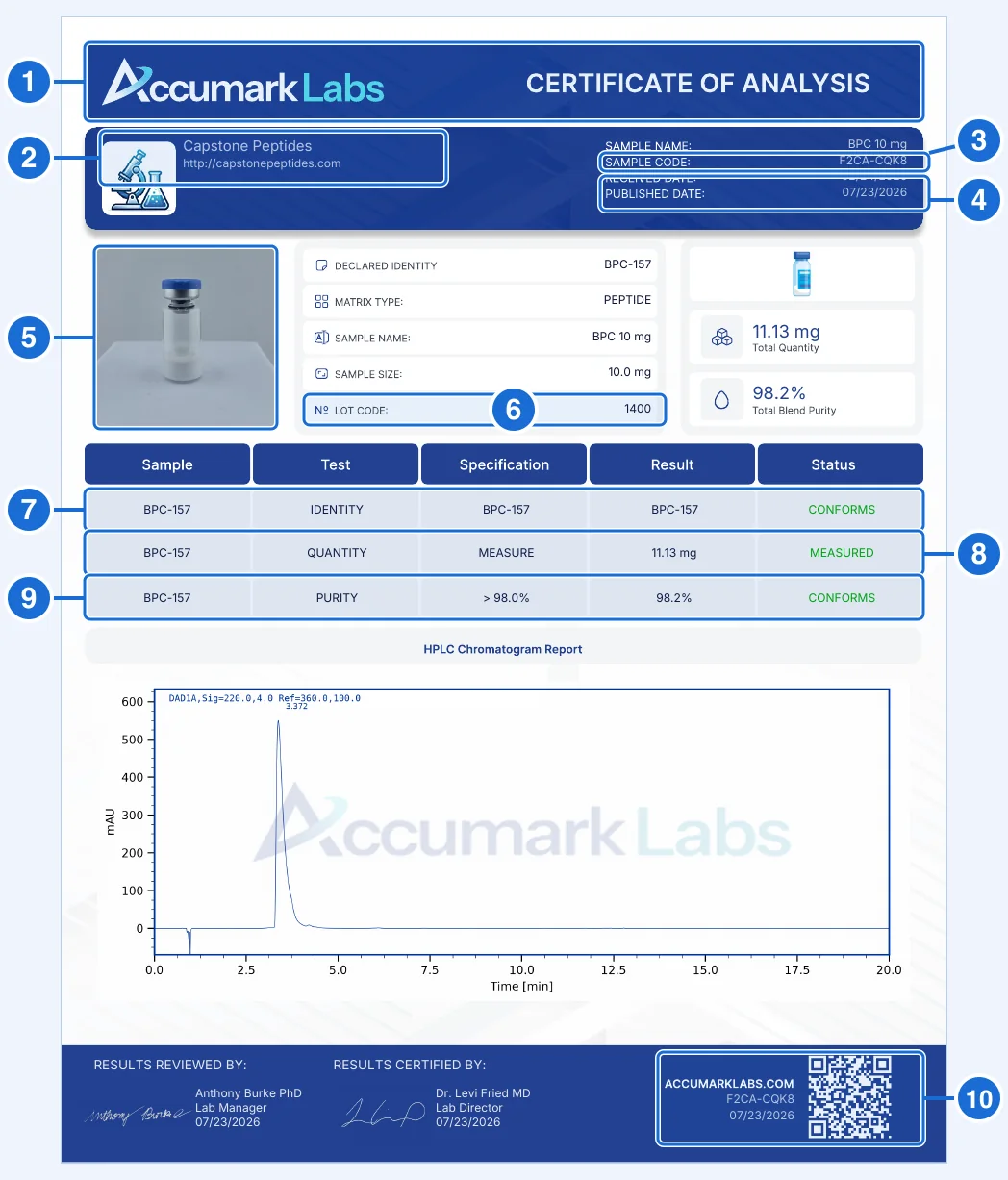
- Lab header. The Accumark Labs logo and title. A genuine certificate names no other laboratory.
- Client. The company the test was run for, with its website. AccuVerify repeats it as CLIENT.
- Sample code. The lookup code, XXXX-XXXX. This certificate calls it SAMPLE CODE; the AccuVerify page calls it REPORT ID and the form calls it Verification Code.
- Received and published dates. Received is when the sample reached the lab; published is the certificate date. AccuVerify shows them as Sample Received and Analysis Completed.
- Vial photograph. The tested vial. Compare the cap, the vial and any label with the one you hold.
- Lot code. The batch to compare with the vial label and the product page. AccuVerify shows it as BATCH / LOT.
- Identity. The declared identity against the identity found; CONFORMS means they agree.
- Quantity. The amount in mg that the lab measured. Its status is MEASURED, not pass or fail, because there is no limit to meet.
- Purity. The limit (> 98.0%) and the measured purity. A result close to the limit still reads CONFORMS.
- Code again, and the QR code. The code repeats above the date. The QR code encodes accumarklabs.com/verify?code= and the same code, which goes straight to the result.
The code is box 3, F2CA-CQK8. In our library 133 of 133 Accumark listings print a code in that shape. The lot (box 6) and the dates (box 4) are what you compare once the record opens.
Two ways in
- Scan the QR code.On the certificate we decoded, it encodes accumarklabs.com/verify?code=F2CA-CQK8 and goes straight to the result. Read the address your phone shows before you read the page.
- Or type the code.Open accumarklabs.com/verify, enter the code with its hyphen and click Verify Certificate. Capital letters do not matter, and the hyphen does: F2CACQK8 without it fails.
- Land on AccuVerify.The address becomes accumarklabs.com/accuverify/?accuverify_code=F2CA-CQK8. Opened with no code, that page shows no result.
- Compare, field by field.Use the table below, and read the dates and the client before the results.
What a real code shows
For F2CA-CQK8 the AccuVerify page opens with a green “Verified & secured” strip, then “Authenticity Confirmed” and the line “This result was generated by Accumark Labs and has not been altered.” Below it, in order:
- Report ID
- F2CA-CQK8
- Client
- Capstone Peptides
- Batch / lot
- 1400
- Sample received
- February 24, 2026
- Analysis completed
- July 23, 2026
- Core panel
- BPC-157 purity 98.2% against > 98.0%; identity BPC-157; quantity 11.13 mg
- Digital Verification box
- Report ID, the verification URL, a VERIFIED timestamp (Jul 23, 2026 · 18:47:55 UTC), data source “Accumark LIMS” and laboratory ID ACL-001, plus a Download PDF button
The record matches the certificate on every field: client, lot 1400, 98.2% purity and 11.13 mg measured. Notice what it adds. The purity limit is > 98.0% and the result is 98.2%, so a result that clears the limit by two-tenths still reads CONFORMS. Notice, too, what a quantity of 11.13 mg says about a vial labeled 10 mg: the lab measured what was in the sample, which is not the same number as the label.
| On the certificate | On AccuVerify | What to check |
|---|---|---|
| SAMPLE CODE | REPORT ID | The same code, character for character. |
| Client name and website (top left) | CLIENT | The seller you bought from, or an explanation of why not. |
| LOT CODE | BATCH / LOT | Compare with the vial label. This is the link between report and vial. |
| RECEIVED DATE | SAMPLE RECEIVED | The same day. |
| PUBLISHED DATE | ANALYSIS COMPLETED | The same day, and a gap you can account for. |
| IDENTITY, QUANTITY, PURITY rows | Core Panel Results | The same compound, mg and percentage, to the same decimals. |
| Extra panels (endotoxin, sterility) | Their own tables on the page | Anything the seller promised appears in the record as well. |
Read the dates and the client before the results
AccuVerify confirms a record. Two of its fields tell you whether the record is the one you think it is.
The gap between received and completed
This record reads sample received February 24, 2026 and analysis completed July 23, 2026, about five months apart. The certificate agrees, so the record verifies. It is still the kind of gap to ask about. Across the 253 distinct codes in our library that we looked up on October 22, 2026, the median gap was 7 days, and 84 of them showed more than 60 days. Our review notes Accumark’s advertised turnaround of 48 to 72 hours. Long gaps can be ordinary (a sample held, a batch published later), so the right move is a question to the seller, not a conclusion.
The client
CLIENT is the company that ordered the test. For 22 of the 253 codes we looked up, it was a different company name from the vendor publishing the code. That can be a supplier or a parent brand, and it can be a certificate that belongs to someone else, so a client name that is not the seller needs a reason.
When the page says Verification Failed
“Invalid verification code. This certificate was not found.” The page repeats the code you entered under “Code entered” and offers Try Another Code and Contact Support. In our test a code without its hyphen failed and the same code in lower case worked, so retype it from the certificate before reading anything into the result. If the exact printed code fails, ask the seller for the original file and write to Accumark.
What AccuVerify claims, and what we cannot check
The page makes three statements about itself: the report was “rendered unaltered from our LIMS” with “no file to edit or swap”, the record is an “immutable record” whose “result hash [is] anchored to blockchain at time of finalization”, and it is “tamper-evident”. They are Accumark’s claims. We cannot independently check the hash anchor from the page, and we do not need it for this lookup: the useful property is simply that the result comes from Accumark’s system by code, so a printed copy that disagrees with it is the copy that is wrong.
Red flags before you look it up
- No sample code, or one that is not two groups of four. Accumark codes are XXXX-XXXX; 133 of 133 listings in our data print that shape.
- A QR code that does not go to accumarklabs.com. A QR code on a copied certificate can point to a lookalike page that always says confirmed.
- A real code on an edited certificate. The code is on every copy, so a doctored certificate can carry a real one. Only comparing the record’s fields with the copy catches it.
- A client that is not the seller. Ask who ordered the test and why.
- A lot that differs from the vial. The record covers the lot it names and no other.
- A header that is not Accumark’s. The certificate names Accumark Labs, signed off by its lab manager and lab director.
Accumark reports in PeptidePrices data
The COA library holds 323 Accumark certificates from 13 vendors, and 229 (71%) have been matched to Accumark’s own record. On the price index, 133 listings show an Accumark report and every one of them carries a matched record: 133 across 9 vendors, 52 of them documenting five or more tests. The vendors with the most matched Accumark listings:
- Paramount Peptides31 matched listings
- Capstone Peptides26 matched listings
- Fro Peptides26 matched listings
- Palmetto Peptides18 matched listings
- V8 Peptides12 matched listings
- OMNI Peptides9 matched listings
Each vendor page shows the certificate beside the listing it covers, with the code kept copyable so you can repeat the lookup. PeptidePrices has no dedicated Accumark checker page yet, so the lookup above is the way to check a certificate you hold. For a checklist that works for any laboratory, see how to verify a peptide COA.
What a confirmed Accumark record does and does not prove
What it proves. Accumark’s system holds a result under this code, and your copy says what the record says. An edited copy would differ from it.
What it does not. The record cannot show that the sample came from your vial, and “Authenticity Confirmed” is a statement about the record, not about your copy. Our review does not call Accumark accredited, as it describes ISO 17025 as pending, so the lookup confirms a record, not a laboratory standard. Only a matching lot ties the report to your vial.
Accumark Labs verification questions
How do I verify an Accumark Labs COA?
Scan the QR code at the bottom right of the certificate, or copy the XXXX-XXXX sample code from the top right, open accumarklabs.com/verify, type it into Verification Code and click Verify Certificate. Accumark's AccuVerify page opens with the client, batch, dates and results. Compare them with the copy you were given.
Where is the Accumark verification code?
At the top right of the certificate as SAMPLE CODE, eight letters and digits in two groups of four (for example F2CA-CQK8), and again at the bottom right beside the date, above the QR code. The same code is the REPORT ID on the AccuVerify page and the Verification Code on the form.
Does the Accumark QR code verify the certificate?
Yes, it is a one-step lookup. On the certificate we decoded, the QR code opens accumarklabs.com/verify?code= followed by the printed code, which loads the AccuVerify result. Check that the address is accumarklabs.com before you trust what it shows, because a QR code on a copied certificate can point to a lookalike page.
What does "Verification Failed" mean on the Accumark page?
AccuVerify found no certificate for the code. The page says "Invalid verification code. This certificate was not found." and repeats the code you entered. The hyphen is required, so a code typed without it fails. Capital letters do not matter. If the printed code still fails, ask the seller for the original file.
What does "Authenticity Confirmed" on AccuVerify actually confirm?
It is Accumark's statement that the result was generated by Accumark Labs and has not been altered, shown beside a record built from its own system. It confirms the record for that code. It does not say your PDF matches the record, and it does not say your vial is the sample. You still compare the fields yourself.
Why does the AccuVerify page look different from my PDF?
AccuVerify rebuilds the report from Accumark's records, so the layout and some labels differ from the PDF: SAMPLE CODE becomes REPORT ID, RECEIVED DATE becomes SAMPLE RECEIVED and PUBLISHED DATE becomes ANALYSIS COMPLETED. The values should be identical. A different lot, date or result is a difference to raise with the seller.
What should I make of the dates on an Accumark report?
Read both. On October 22, 2026 we looked up the 253 distinct Accumark codes in our library: the median gap between Sample Received and Analysis Completed was 7 days, and 84 showed more than 60 days. A long gap can have an ordinary explanation, such as a batch published later, so ask the seller instead of assuming.
Which peptide vendors publish the most Accumark reports?
On the PeptidePrices price index, 133 listings from 9 vendors carry an Accumark report that matched Accumark's own record. The vendors with the most are Paramount Peptides (31), Capstone Peptides (26), Fro Peptides (26), Palmetto Peptides (18), V8 Peptides (12) and OMNI Peptides (9).
Does a verified Accumark report prove my vial was tested?
No. A verified report proves Accumark recorded these results for the sample it describes. It does not prove the vial you hold is from that batch. The client, compound, strength and lot on the record must match your vial label and the product you bought, and a client that is a different company from the seller needs an explanation.